




 Arts & Culture
Mastering the Clay: Historic Japanese Ceramics
Japan officially designates over two hundred traditional craft industries under the Ministry of Economy, Trade and Industry. These practices have successfully survived centuries of rapid modernization. This guide details the technical processes, regional roots, and preservation methods of these historic industries.
Understanding these techniques provides a clear pathway to appreciate their design principles and collect authentic pieces. If you want to explore the rich cultural heritage of Japan, there are several Traditional Japanese Arts and Crafts You Should Discover to truly appreciate the country’s artistic soul.
An Overview of Iconic Japanese Crafts
To assist in navigating this rich heritage, we compiled a guide to the key Traditional Japanese Arts and Crafts You Should Discover on your cultural journey.
| Craft Category | Key Regional Styles | Primary Materials Used |
|---|---|---|
| Ceramics | Bizen, Arita, Shigaraki | Natural clay, wood ash, cobalt glazes |
| Lacquerware | Urushi Ware | Rhus verniciflua tree sap, wood |
| Textiles | Aizome (Indigo), Nishijin-ori (Silk) | Polygonum tinctorium leaves, silk threads |
| Metalwork | Tamahagane Swords, Tsuiki Copper | Iron sand, copper sheets |
The Rustic Beauty of Bizen and Shigaraki
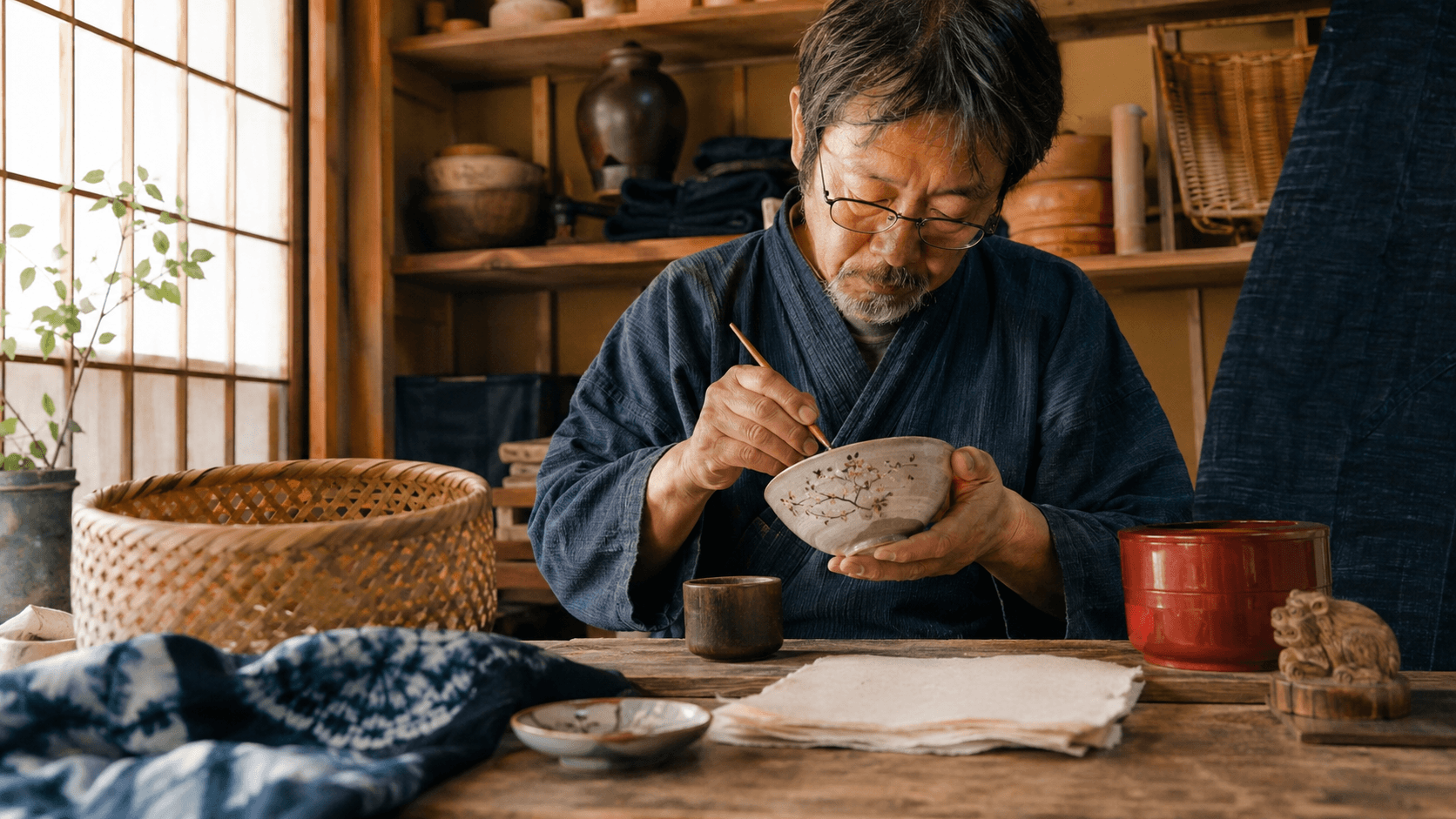
Japanese ceramic work spans ten millennia. This makes it one of the oldest unbroken pottery traditions on Earth. Local clay formulas and regional kiln layouts generated starkly different visual styles across the islands.
Makers rely on wood-fueled kilns called anagama. These structures produce raw surface textures without the use of chemical glazes. Bizen pottery exemplifies this earthy design style by undergoing a grueling fourteen-day firing cycle.
Temperatures inside the chamber reach twelve hundred degrees Celsius. Flying wood ash and direct straw contact create the final surface patterns naturally. When exploring Japanese pottery, you will find some of the most notable Traditional Japanese Arts and Crafts You Should Discover, each telling a unique story of regional clay and ancient kilns.
Pottery centers developed near rich clay deposits. These historical sites, known as the Six Ancient Kilns of Japan, established the early look of Japanese stoneware. Today, modern creators still dig clay from these same veins to capture its unique reaction to fire.
- Bizen ware features earthy tones and natural ash glazes from long pine-wood firings.
- Arita ware showcases bright blue-and-white porcelain designs influenced by historical imports.
- Shigaraki ware incorporates coarse clay with distinctive quartz pebbles for a rustic texture.
The Luminous Depth of Urushi Lacquerware
Urushi lacquerware uses the natural sap of the lacquer tree, a relative of poison ivy, to coat wooden objects. This liquid contains urushiol, a compound that cures only when exposed to high humidity and warmth. Woodworkers apply up to thirty microscopic coats to a carved wooden base, hand-polishing every layer with charcoal.
This meticulous method produces a surface impervious to water, acid, and heat. For those seeking functional elegance, Urushi lacquerware represents one of the highly durable Traditional Japanese Arts and Crafts You Should Discover during your travels. Owning a piece requires basic care to keep its glossy finish pristine over decades of daily use.
- Hand-wash Urushi items using warm water and a soft cloth without abrasive detergents.
- Store lacquerware away from direct sunlight to prevent ultraviolet rays from degrading the natural sap.
- Keep a small cup of water nearby in dry display cases to maintain necessary ambient humidity.
Indigo and Silk Textile Masterpieces
Japanese textile arts highlight a deep connection to seasonal botany and precise geometry. Beautifully dyed textiles like Aizome indigo represent another category of Traditional Japanese Arts and Crafts You Should Discover if you appreciate slow fashion and natural colors. This natural dye relies on the fermented leaves of the Japanese indigo plant, which require a full year of preparation.
The deep blue hue shields fabrics from insects and adds natural flame-retardant qualities to cotton clothing. Samurai warriors favored indigo undergarments for these protective traits and their antibacterial properties on the battlefield. Today, Tokushima prefecture remains the central hub of traditional indigo cultivation.
In Kyoto, Nishijin-ori weavers employ complex handlooms to weave intricate silk brocades for ceremonial kimonos. This process involves more than twenty separate steps managed by specialized craftsmen, ensuring extraordinary textile density. The finished silk reflects light at multiple angles due to woven gold and silver threads.
Kyo-yuzen dyeing uses a paste-resist method to paint detailed scenes directly onto silk fabrics. This technique lets makers paint highly detailed seasonal landscapes and realistic plant illustrations. Historically, the finished textiles were rinsed in the cold waters of Kyoto’s rivers, a practice now largely moved to specialized indoor facilities to protect the environment.
- Kyoto serves as the epicentre for Nishijin-ori luxury silk weaving and Kyo-yuzen dyeing.
- Tokushima remains the primary producer of natural Sukumo indigo dye.
- Okinawa produces Bingata, a unique multi-colored stencil-dyed cotton fabric.
Precision Metalwork and the Legacy of the Katana
The art of Japanese smithing grew directly from the military demands of the feudal samurai class. Artisans smelt iron sand in clay tatara furnaces for seventy-two hours to produce a high-carbon steel called tamahagane. Swordsmiths repeatedly fold this steel up to fifteen times to spread carbon evenly and remove flaws.
From the legendary swords of the samurai to modern kitchen knives, Japanese metalwork offers some of the most remarkable Traditional Japanese Arts and Crafts You Should Discover. Modern kitchen knife makers in Sakai apply these exact folding techniques to create professional kitchen tools. These knives keep their sharp edge far longer than standard industrial blades, earning high praise from professional chefs worldwide.
Traditional copperware from Tsubame-Sanjo shows the mastery of hammering flat metal sheets into complex vessels. This technique, called Tsuiki, requires the maker to strike the copper tens of thousands of times. Constant hammering hardens the metal, making the final copper vessel light and incredibly strong.
The Resilient Fibers of Washi Paper Making
Washi paper uses the inner bark of three specific plants: Kozo, Mitsumata, and Gampi. This labor occurs during the coldest winter months to stop bacterial growth in the pure mountain water. Papermakers filter the plant fibers through bamboo screens, creating a flexible, translucent sheet that lasts for over ten centuries.
This lifespan far exceeds modern wood-pulp paper, which decays due to high acid content. Historic temples use washi for sliding doors and record scrolls that remain intact today. If you love organic textures and historic stationery, traditional washi paper is one of the delicate Traditional Japanese Arts and Crafts You Should Discover.
Preserving Heritage in the Modern Era
Buying pieces from these heritage workshops directly funds the survival of irreplaceable cultural knowledge. Supporting these heritage industries ensures that the Traditional Japanese Arts and Crafts You Should Discover remain active for future generations to cherish. These hand-made items offer a real alternative to modern disposable throwaway culture.
To begin collecting, start with smaller functional items like a ceramic tea bowl or an indigo-dyed cotton scarf. Verify the regional origin through official craft associations to ensure authenticity. Proper care guarantees that these hand-crafted masterpieces will serve as family heirlooms for generations.


Comments are closed